
1.2 ANATOMY OF A PRINTED BOOK
Let’s start by defining what a printed book is. Physically a printed book is a set of pages that come together and are protected by a front cover and a back cover, Occasionally a book may have a detachable dust jacket with a flipping part that folds inside the front and back cover. However, the soul of the book is its content, the most important part of it.
1.2.1 Physical parts of the book
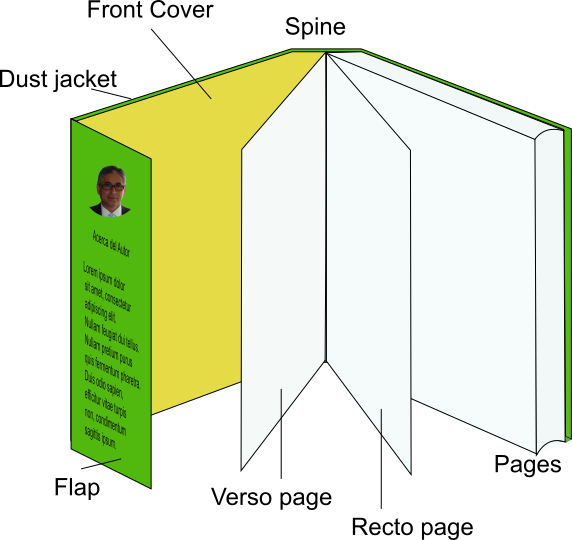
A printed book may have the following physical parts:
- Dust jacket (optional). The dust jacket is a detachable outer cover, made of paper and printed with text and illustrations as a marketing tool.
- Front and Back cover (Hard or Soft). The front / back cover is protective material used to bind together the pages of the book. Normally the front cover has the cover art, book title, and author’s name. The back cover often contains author’s biography.
- Spine. The spine joins the front and back cover. On the spine the pages are attached. the spine area has the book title, authors’ name and publisher logo.
- Set of pages. Each leaf (sheet) of the book has two faces or pages, the frontal page is called the recto and the back page is called the verso. The set of pages contains front matter, body of the book, and back matter.
1.2.2 Content of the Book
The content of the book’s content is organized into three main parts:
Front Matter
Click on the flipbook pages below to see front matter content.
Fly leaf (Optional)
A blank page in the front or back of a book.
Half Title
On a recto page, contains the title at the middle of the page.
Frontispiece (Optional)
This page, on the back of the half title, tells readers about other books published by the author.
Title Page
This section is requiered on a recto page facing the frontispiece (if there is one). This page has the title of the book, subtitle, authors, and publisher’s name. This is the third page without page numbers.
Copyright
This page is located on the verso of the title page. It may have: a copy right notice, date of publication, edition, dates of previous editions, acknowledgments of any copyrighted material used with permission, full name and address of the publisher, country where the book was printed, information on font, typeface, or paper used in printing, and attribution for contributors. No page numbers yet.
Dedication (Optional)
This page is located after the copyright page.The page provides the author a way to thank persons who had a critical impact on your work. You usually find a Roman numeral page number (v).
Epigraph (Optional)
An epigraph is a brief statement that can be a question, a quotation, or even a poem that introduces a chapter and serves to highlight its theme or main idea. This frequently links the current work to earlier efforts that had comparable concepts and insights. Normally faces the Table of Content page. Use the page number (vi). If there is no epigraph then the page is left blank with no numeration.
Contents
A list of parts, chapters and sections of the book with their respective page numbers. It helps readers navigate the book. It will contain all the front matter pages that appear after it.
List of figures and tables
If your book contains multiple figures and crucial tables that give information or enhance the text in some manner, consider including a page listing them. If this item is only given as a visual assistance, a page listing may be unnecessary. You will not need to provide the page numbers, just like you would in the table of contents.
Foreword (Optional)
An introduction to a book written by someone other than the author that supports the author’s authority to write the book.
Preface
A preface is an introductory section written by the book’s author. It explains why the book exists, its subject matter, and its objectives. Prefaces are more common in nonfiction books, but they can also appear in fiction. It always appears in the next recto page after the contents.
Acknowledgments
The acknowledgments, like the dedication, are intended to honor important people in our life. Unlike the dedication, these are often found at the end of the book and can be written in extended paragraphs rather than a single brief statement.
The Body or Main Text
The body of the book contains all the information that the author wishes to deliver. Traditionally this information is made of text, images and eventually tables. The information is organized in chapters, chapters in sections, sections in pages, pages in paragraphs, paragraphs in sentences and sentences in words.
Click on the flipbook pages below to see the body or main text content.
Parts
When there is significant structural or historical variation across portions, a book might be separated into divisions. Start each part on a new recto page, with a verso in blank. Normally written as Part I or Part One, etc.
Chapters
Chapters normallly have heading and subheadings, which divide chapter into smaller sections. For example this chapter have headings, and subheadings color coded.
Sections
A section of a literary work, particularly a narrative, is frequently titled or numbered.
Conclusions / Epilog (Optional)
The essential ideas and principles of the essay are summarized in the conclusion.
The epilogue occurs after the tale has come to an end. It serves to summarize the action, provide the reader a character update, and giving the reader a sense of closure.
Afterword
An afterword can be used to convey further information about the book’s topic, origin, or a link between the novel and actual events. Sometimes it’s a message from the author to the readers.
Books can be categorized based on two genres: fiction and non-fiction. Each of these genres have subgenres according to the type of content of the book. A sample of the most common subgenres is given in the following list, although the lists are not exhaustive. Click on the list.
Fiction Subgenres
Action and Adventure
Anthology
Children’s
Classic
Comic book
Crime
Drama
Fairytale
Fantasy
Graphic novel
Historical fiction
Horror
Mystery
Romance
Picture book
Poetry
Satire
Science fiction
Short story
Suspense
Thriller
WesternYour Attractive Heading
Non-Fiction Subgenres
Art / Architecture
Biography
Business / Economy
Crafts / Hobbies
Dictionary
Cookbook
Encyclopedia
Guide
Health / Ftness
Hystory
Home and Gardem
Humor
Diary
Mathematics
Philosophy
Prayer
Science
Self help
Sports and Leisure
Travel
True Crime
Textbook
Back Matter
The back matter is all the information that goes after the book’s content. This part contains supplemental information that helps readers the reading experience. The back matter may have the following parts:
Click on the flipbook pages below to see back matter content.
Appendix (Optional)
An appendix contains any data that may help the reader understand the content but would have interrupted the flow of the main text if presented earlier in the book. A list of references, tables, reports, background research, and sources may be put here if they are not broad enough to warrant their own section.
Endnotes (Optional)
If your main text requires notes to amplify or document specific passages, please organize them by chapter in a notes section. Footnotes would most likely be provided in the reference section.
Glossary / Abbreviations (Optional)
A glossary is a collection of alphabetically sorted terms and definitions. Include one if you utilize terminology that is unfamiliar to the average reader, or if you create new words or phrases to describe your thoughts.
Bibliography / References
This is al list of all the works cited in the book, normally using the Chicago Manual of Style. For scientific books the APA (American Psychological Association) style is used
Index (Optional)
Alphabetical list of all important terms used in the book with their respective page number.
Biography / About the Author (Optional)
This is an excellent opportunity to engage with your reader on a personal level while also developing your all-important author brand: websites, online courses, and other publications. Perfecting your author bio will help you sell more books in the future.
Fly Leaf
A blank sheet.
Colophon
The printer used the colophon to document the book’s manufacturing information, such as the title of the publishing company, the location and date of production, and possibly even the coat of arms.
Assessment