
Natural and Whole Numbers – Place Value
OBJECTIVES
- be able to count up to hundred.
- differentiate between natural and whole numbers.
- differentiate between a numerical representation, its name and a number.
- name the different orders of decimal numbers.
- identify the place value of a digit in a given number.
- explain the difference between ones, tens, hundreds on a three digits decimal.
- explain why the largest possible digit in any order is 9.
- name four different period of a decimal number.
- read and write whole numbers.
Counting
A number is mental concept we use to represent the size of an objects collection. The set or collection of numbers used to count the elements of any group of objects is the set ℕ = {1, 2, 3, 4, …} called natural numbers. If zero is included, then we get the set of whole numbers ℤ+= ℕ+ {0}.
The Hindu-Arabic symbols 0, 1, 2, 3, 4, 5, 6, 7, 8, 9 are called digits. They are used to count objects by groups individual object or ones, tens (groups of ten ones), hundreds (groups of ten tens), thousands (groups of ten hundreds), millions (groups of ten thousands) , and billions (groups of ten millions). (Note there are ten digits).
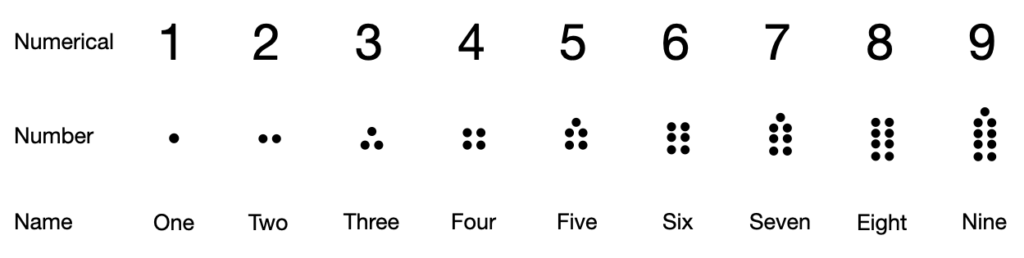
A number is a characteristic of a group, collection or set. A number describes the number of elements, called also cardinality. The numerical representation is a visual representation of the number, while the name is used to verbally express the numerical representation.
A set consisting of ten elements is called a ten. A set consisting of ten tens is called a hundred. A set of ten hundreds is called a thousand.
If we have one object, for example, one ball, we say we have a zeroth-order group (100 = 1), or simply: a unit. A ten, a group of ten objects, is called a first-order group (101 = 10), a hundred, a group of ten tens, a second-order group (102 = 100), a thousand, a group of ten hundreds, a third-order group (103 = 1000), and ten thousand, a group of ten thousands, a fourth-order group (104 = 10000), and so for.
Suppose we want to count the elements of some objects collection, for example, marbles; we can do this as follows: First, we arrange the marbles into tens. This gives us a certain number of tens, let’s say five tens 5×101 = 5×10), and a few separate marbles, for example, six (6×100 = 6×1 = 6). Then we arrange the tens in groups of ten, we call them into hundreds. Eventually, we’ll be left with fewer than ten tens, for example, five tens. Let’s suppose we end up with, for example, eight hundreds 8×102 = 8×100). Our set therefore consists of eight hundred, five tens, and six separate marbles. We say that the total number of marbles is eight hundred fifty-six.
Writing Numbers.
In the previous example, we had eight hundred, fifty-six marbles. We write this number as follows: 856 = 8×10²+ 5×10²+ 6×100
This symbol, 856, is composed of three digits. The number 6, standing in the first place (counting from the right hand), tells us how many balls were left separately; the numbers in the second, and third place show us, respectively, how many tens, and hundreds we received separately.
If, proceeding as before with a set of marbles, we do not obtain separate marbles, or tens, hundreds or thousands of them, we mark this lack by writing the number zero in the appropriate places.
This strategy can be generalized to counting methods using a different groups, like counting by two, fives, eights, twelves and sixteens. A numerical positional system base b, b being a whole number greater or equal to 2, is a representation of a quantity N= (a0a1…an)b in base b in the following expanded way: N = a0b0 + a1b1 + … +anbn . where a0, a1, a2, … an are the 0-order, 1st-order, … nth-order digits of the number. The digits need to be any of following symbols 0, 1, 2, .. b-1.
Examples: (16)10 = 1×101 + 6×10 = 10 + 6, is sixteen in base 10 (Decimal). Their symbols are (0,1 ,2 ..,9).
(10000)2 = 1×24+ 0×23 + 0×22 +0×21 + 0×20= (16)10, is sixteen in base 2 (Binary). Their symbols are (0, 1).
(31)5 = 3×51 + 1×50= 15 + 1 = (16)10, is sixteen in base 5 (Quinary). Their symbols are (0, 1, 2, 3, 4).
(20)8 = 2×81 + 0×50= 2×8 + 0 = (16)10, is sixteen in base 8 (Octal). Their symbols are (0, 1, 2, 3, 4,5 ,6, 7).
(10)16 = 1×161 + 0×160= 1×16 + 0 = 16, is sixteen in base 16 (Hexadecimal). Their symbols are (0, 1, 2, 3, 4,5 ,6, 7, 9, A , B, C, D, E, F).
When a number is represented by more than three digits, its common to separate them by commas or spaces, for example 97,521,234,010 or 97 521 234 010. I recommend the later method since in Europe and Latin America the comma is used to separate the fractional part of decimals. The expanded form of this number is: 90 000 000 000 + 7 000 000 000 + 500 000 000 + 20 000 000 + 1 000 000 + 200 000 + 30 000 + 4 000 + 10. The groups of three digits are called periods. The concept of period will simplify the writing and reading of any number.
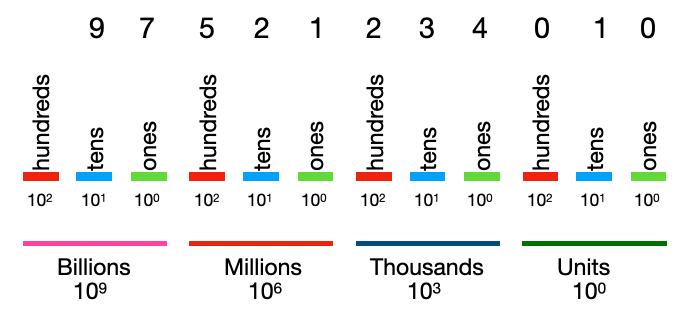
Digit 9 is in the tens of billions period, its value is 9 tens billions, or ninety billion.
Reading Numbers.
The digits in the number sign are called (proceeding from right to left) the units, tens, hundreds, thousands, and millions digits. The number 97 521 234 010 is read:
- 97 – Ninety seven billion
- 521 – five hundred twenty one million
- 234 – two hundred thirty four thousand
- 010 – ten
Assessment