

Section 3
3
The Relation of Physics with Other Sciences
The Relation of Physics with Other Sciences
At the end of this lesson you should be able to:
- Explain how Physics has influenced the development of Chemistry, Biologic Sciences.
- Explain how Physics has influenced the development of Material Sciences.
- Explain how Physics has influenced the development Environmental and Atmospheric Sciences.
- Explain how Physics has influenced the development Astrophysics and Cosmology.
- Explain how Physics has influenced the development of Cognitive Sciences.
1.3 The Relation of Physics with Other Sciences
Introduction
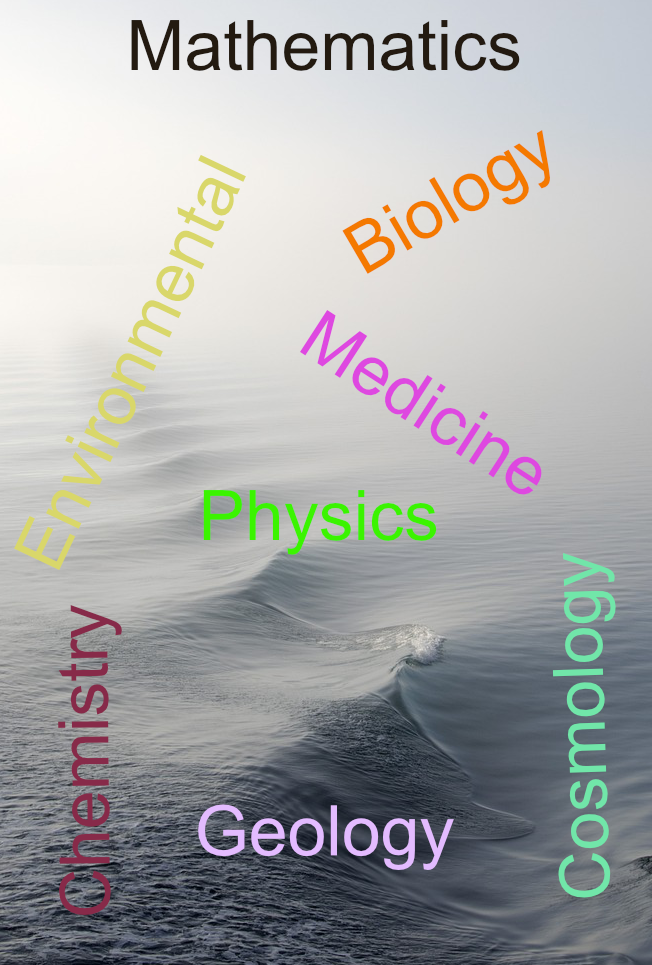
Due to the ambitious goal of physics and its progress during the last two centuries, the concepts, theories and methods developed have helped other sciences to progress. It is for this reason that interdisciplinary sciences have been developed in which physics plays a very important role. Let’s mention some examples:
Chemistry, Biology and Medicine
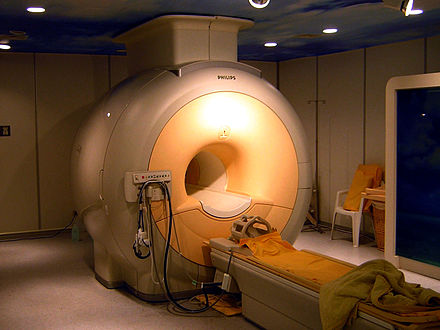
In these areas the development of quantum theories and quantum statistical mechanics have helped to understand the formation of complex molecules and have led to the development of radiological techniques such as X-rays, Magnetic Resonance Imaging (MRI) see figure 3.1, Ultrasound, Electron Microscopy, and Computarized Tomography that greatly have helped the understanding of cellular processes and animal tissues.
These advances have led to the birth of new sciences such as biochemistry, molecular biology, biophysics, and molecular medicine, among others.
Material Sciences
Materials science is an interdisciplinary field of engineering that uses the basic concepts of physics that describe the constitution of matter, its interactions, and its physicochemical properties.
Two areas that contributed to the modern advancement of materials science were the space race and the development of semiconductor devices. Space race said advances in the area of metallurgy and the better understanding of materials such as silicon and carbon. New materials and alloys were developed. Examples of this are elastics, plastics, semiconductors and biological materials.
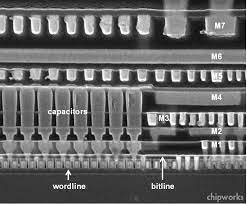
The other area of development is that of nanotechnology. This area especially developed for the manufacture of electronic devices with elementary units of size of the order 1 to 1,000 nanometers (10-9 m). The manufacture of these materials is done using sophisticated Chemical Vapor Deposition (CVD) equipment. With this equipment it is possible to manufacture integrated circuits up to ten layers, as seen in figure 1.3.2. Together with these developments, new techniques for measurement and characterization of materials were developed. Electron microscopes, IC decomposition equipment using plasma chambers with radio-frequency electromagnetic fields (RIE – Reactive Ion Etcher) and new radiation detection equipment were developed.
Environmental and Atmospheric Sciences
Theory and experiments to date say that protons and neutrons are not elementary but are themselves composed of particles that are currently considered elementary called quarks, of which there are six types with different flavors (u, c, t, d, s, b). Quarks are part of particles called hadrons (from the Greek άδρός meaning strong).
Other type of particles that until today seem to be elementary are leptons (from the Greek λεπτός which means light) and bosons (in honor of Satyendra Nath Bose). To the class of leptons belong the electron (from the Greek ήλεκτρον which means amber), the muon (μ), tau (τ) and its corresponding antiparticles and neutrinos. To the class of bosons belong the photons, the gluon (g, from the English glue, which means glue), and the bosons W+, W–, Z. and H, which are the carriers of the interactions. Figure 2.6 shows the model that classifies all currently known elementary particles.
Cosmology and Astrophysics
The discoveries of atomic theory, the theory of relativity and nuclear physics at the beginning of the 20th century gave rise to the birth of cosmology as a science. The formulation of theories about the formation and dynamics of the universe as a whole led to the collection of data to validate the theories. The data acquired from the observation of light coming from systems far from the solar system is analyzed using spectroscopic methods developed based on the atomic theory of matter.

Cognitive Sciences
Throughout the history of physics, theoretical and experimental physicists have always neglected to mention clearly that what we do to know the universe is a result of the activities of the brain. So the relationship of physics to cognitive science is extremely close.
Cognitive neuroscience has made substantial progress in associating parts of the brain with specific functions. These achievements have been made in large part thanks to the techniques of interpreting images taken with positron emission tomography or PET (Positron Emission Tomography) and functional magnetic resonance imaging or fMRI (Functional Magnetic Resonance Imaging).

Assessment
Solve the Crossword
Multiple Selection Quiz
